

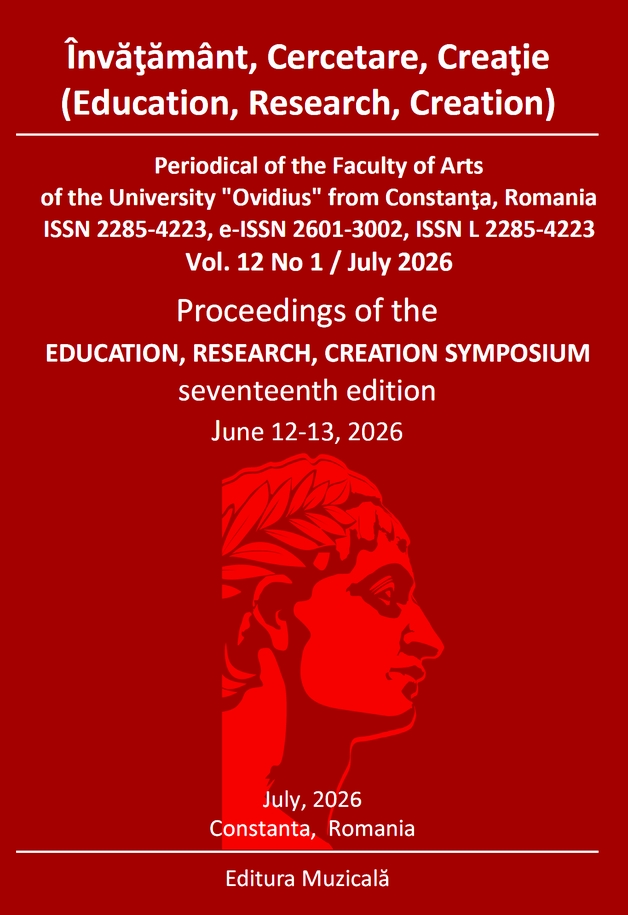
VOL. 12, No.1 - 2026
-
 Daniela VITCU, Dean of the Faculty of Arts of the University “Ovidius” from Constanţa, RomaniaFOREWORD
Dear Authors, esteemed Readers,
It is with deep satisfaction that I write this Foreword to the 12th volume (No. 1/2026) of the “Învăţământ, Cercetare, Creaţie”, periodical of the Faculty of Arts of the University “Ovidius” from Constanţa, Romania. Edited by Musical Publishing House, Bucharest, our publication, which is Indexed in I.D.B. - ERIH PLUS and CEEOL.
This issue contains the Proceedings of the 17th International Symposium “Învăţământ, Cercetare, Creaţie - Education, Research, Creation” (I.C.C.).
I.C.C. continues a tradition of bringing together researchers, academics and professionals from all over the world, experts in arts and human sciences. ...
Articles
-
Ioan ARDELEAN
Technical-stylistic dimensions in the interpretation of the role of Scarpia from the opera Tosca by Giacomo Puccini
The present work aims to analyze the technical-stylistic dimensions involved in the interpretation of the role of Baron Scarpia in Giacomo Puccini's opera Tosca, approaching the role from an interdisciplinary perspective that combines musicological, vocal-technical, dramaturgical and interpretative analysis. Starting from the study of the score, specialized literature and reference recordings, the research highlights the way in which Puccini constructs a negative character of exceptional dramatic force, as well as the complex requirements imposed on the contemporary interpreter. The elements of vocal technique, the construction of the musical phrase, the relationship with the orchestra, the use of the leitmotif and the scenic strategies that contribute to the shaping of a convincing and stylistically coherent interpretation are analyzed. The study also follows the way in which the interpretive tradition has evolved from 20th century models to contemporary directorial and aesthetic perspectives, in which Scarpia is perceived not only as an antagonist, but also as an expression of the institutionalized abuse of power. ... -
-
Nicoleta Mihaela ARDELEAN
Phenomenological intersections in the dramaturgical journey of the protagonist of the opera Tosca. A structural-hermeneutic analysis
The paper proposes a critical evaluation of the dramaturgical profile of Floria Tosca, the protagonist of the homonymous opera by Giacomo Puccini, through a double methodological grid: structural and phenomenological. Going beyond traditional interpretations that place the work exclusively in the paradigm of raw verism, the study follows the way in which the affective experiences of the character Floria Tosca are organized in an existential path marked by tension, rupture and self-determination. The force and tension of this dramatic evolution are illuminated by the analysis of the musical text doubled by essential fragments from Puccini's epistolary correspondence. The research proposes an interpretation of emotion as an intentional act of consciousness and examines the intersections between love, jealousy, faith, violence and sacrifice in the dramatic construction of the character. Finally, the paper demonstrates how the protagonist's journey evolves from an aesthetic existence to a tragically pure consciousness, which reclaims its ontological freedom through the radical act of transcending immanence. ... -
-
Oana BĂLAN-BUDOIU
Conceptual mapping of the „artist-audience” relationship. Managerial perspectives in „music mediation”
Building on historical case studies, documented by practice, the present aritcle identifies two recurring typologies through which the artist-audience relationship has been negotiated: the responsive-formative model and the influence-network positioning model. Sociological analysis reveals that the cultivation of musical taste is an acquired social construct, one that may develop through education and musical immersion. Considering this, knowledge of music mediation becomes a significant element in musicians’ lives, with the artist-audience dialog representing an important step in the management of contemporary music careers. This article examines the historical evolution of the artist-audience engagement, tracing the mechanism underlying this phenomenon. ... -
-
Florin BĂLAN, Noemi KARACSONY
Contemporary Romanian Creative Poses-2025 Commercial Segment
The characteristics of the commercial creative segment in the central Balkan area are anchored in the definition of the local modern artistic identity. Normal and logical existence and deepening of specific elements, thus the zonal delimitation outlining the relevance and consistency, the bordering space related to the peoples of Romanian, Bulgarian, Serbian, Croatian, Macedonian origins, constituting the favorable environment for the display and propagation of the artistic product. Particularly interesting and at the same time worthy of analysis is the context of the approach to the construction of traditional local structures, namely the additional implementation of the elements characteristic of modern styles propagated daily in the mass media, the resulting constellation being a compiling, effective one, with a positive impact on the preferential tastes of the public general. Thus, the current musical productions analyzed (2022-2025), in the techno-dance, neo-soul, hip-hop styles or even jazz-etno mergers, mainly the primordial implementation of typical (Balkan) structures outline the weight, the remarkable relevance obtained in the compilatory form. For the success of a concise analysis, highlighting the specific elements, the object of the creative moment in the central eastern European commercial area, we intentionally chose 3 pieces of different invoices. ... -
-
Laura BILIC
It’s Not Like It Used to Be – and That’s the Problem
Rapid cultural and technological shifts are profoundly changing how people grow up, learn, and relate to the world. Generational differences are becoming increasingly visible, shaped not only by historical events but especially by the accelerating pace of technological change. Today’s students have instant access to information, yet often struggle with deep processing and with tolerating discomfort. In this context, traditional authority and mistake-correction-based methods are losing their effectiveness. What becomes necessary is a shift in perspective: a learning process grounded in dialogue, vulnerability, and mutual adaptation. Feedback takes on the role of shared exploration, focused on individual resources and potential. The pedagogical relationship turns into a partnership, where authenticity and openness are no longer optional but essential conditions for development. Continuous adaptation to present reality remains a fundamental responsibility. ... -
-
Andreea BRATU
The Final Years of Dinu Lipatti: Live Performance, Recordings, and Personal Struggle (1947–1950)
This article examines some aspects of the final years of Dinu Lipatti (1947–1950) through the intersection of illness, concert activity, recordings, compositional work, and correspondence, arguing that these years should be understood not as a passive period of decline, but as a phase of artistic compression and intensified self-definition. Drawing on concert programs, recording chronologies, archival documents, letters, and testimonies from collaborators and friends, the study reconstructs the transformation of Dinu Lipatti’s public and creative activity in his last years. The article also analyses part of Dinu Lipatti’s correspondence with musicians, mentors, friends, and family in Romania and Western Europe as a documentary space where artistic discipline, financial pressure, medical uncertainty, and future aspirations converge. Although important studies have examined Lipatti’s recordings and archival documents, these sources have rarely been integrated into a unified historical interpretation of his final years. . Rather than attempting an exhaustive reconstruction of his final years, the article focuses on key events, recordings, performances, and documents most relevant to understanding the relationship between illness, artistic activity, and interpretative concentration in the last phase of his career. The central argument is that Dinu Lipatti transformed physical limitations into a refined artistic economy, visible in repertoire selection, interpretative concentration, and the documentary traces left by his final years. ... -
-
Andreea BRATU
The Piano Accompanist as Co-Interpreter. Functional and Expressive Dimensions in Vocal and Instrumental Repertoire
This article explores the role of the piano accompanist as a co-interpreter in both vocal and instrumental repertoire, moving beyond the traditional view of accompaniment as merely a supportive function. It examines the functional dimensions of pianistic collaboration, including harmonic support, rhythmic coordination, and structural guidance, while also foregrounding its expressive contribution to phrasing, dynamics, agogic nuance, and musical character. The study highlights the specific demands of instrumental accompaniment, defined by timbral balance and technical interaction, as well as those of vocal accompaniment, shaped by text, breathing, and diction. By focusing on shared interpretative responsibility, the paper argues that the contemporary piano accompanist plays an essential role in the creation of musical meaning and should be regarded as an equal artistic partner in performance. ... -
-
Miruna CĂRĂUȘU
Feminine Visual Motifs in the Romani an Art Scene at the Turn of the 20th Century: A National Visual Repertoire in a European Context
The early 20th century marked a period of profound social, cultural, and artistic transformation in Romania, characterized by an accelerated process of modernization and alignment with Western values. In this context, art became not only a means of aesthetic expression but also a tool for reflecting on and reinterpreting emerging social dynamics. One of the essential aspects of this period was the redefinition of women’s status, both in society and in artistic representations. Femininity, as a visual theme, occupies a central place in the work of Romanian artists at the beginning of the 20th century, being explored in a variety of guises—from classical and symbolist idealization to more intimate, everyday, or even introspective representations. Women are present both as objects of aesthetic contemplation and as bearers of cultural, social, and symbolic meanings. At the same time, this period also marks the beginnings of women’s emergence as creative subjects, with the appearance of the first female artists who managed to carve out a place for themselves in a predominantly male artistic medium, contributing to the diversification of visual perspectives on femininity. ... -
-
Inga CEBAN
The Tchaikovsky Ballet Trilogy: Formal Architecture, Harmonic Language, and Timbral Dramaturgy
Ballet represents a model of synthesis between form, harmony, and dramaturgy, being ideal for the analysis of applied musical forms, the study of expressive harmony, the understanding of Romantic orchestration, and the relationship between music, movement, and psychology. Swan Lake, The Sleeping Beauty, and The Nutcracker constitute a fundamental trilogy in the history of ballet music, marking the transformation of the genre from a predominantly choreographic form into a symphonic-dramatic musical construction. This article proposes a comparative analysis of these works from the perspective of musical forms, harmonic language, and the dramaturgical function of orchestration, highlighting the evolution of Pyotr Ilyich Tchaikovsky’s compositional thinking and his decisive contribution to the consolidation of modern classical ballet. ... -
-
Daniela COJAN
From Novel to Musical: Adapting Les Misérables from Page to Stage (West End musical)
This article examines the ways in which the stage adaptation of Hugo’s novel reconfigures the narrative structure, character construction, and central thematic concerns of the original work. Employing a comparative analytical framework, the study investigates the relationship between the novel and its musical adaptation, emphasizing how the theatrical and musical medium facilitates a reinterpretation of the source text. Particular attention is given to the transformative impact of a canonical literary work on one of the longest-running musical productions worldwide, highlighting the dynamics of adaptation across genres and artistic forms. ... -
-
Laura Sinziana CUCIUC ROMANESCU, Özlem KAYA
Reproduction of Local Color Codes in the Globalization Process
Globalization has significantly transformed fashion and textile design by enabling the rapid circulation of cultural symbols, aesthetic sensibilities, and design practices worldwide. In this process, local cultural elements do not disappear entirely; rather, they are reinterpreted and reproduced in different forms within global design systems. One of the most visible elements of this transformation is local color codes, which are closely related to cultural identity and geographical context. Color has historically been an important cultural indicator reflecting the natural conditions, traditional production techniques, and social meaning of specific geographies. Color palettes used in fashion design represent the visual identity of local cultures while also functioning as an aesthetic and symbolic tool in design processes. Today, the fashion industry draws inspiration from local textile traditions and color cultures, reinterpreting these color codes with a contemporary design approach and presenting them to the global market. This study aims to examine how local color codes are reproduced within the context of fashion design in the process of globalization. The study also addresses how color palettes derived from traditional textile cultures are used in contemporary fashion collections and textile surface designs. Evaluations of selected design examples aim to reveal how local color codes are transformed and reinterpreted within the global fashion system. It also discusses whether this process contributes to the preservation of cultural identity or leads to the commercialization of local cultural values within the global fashion industry. ... -
-
Laura Sinziana CUCIUC ROMANESCU, Adriana Claudia CÎTEIA
Narragonia: the Search for Subjective Paradise in the Work of Sebastian Brandt
Under the thin ideological crust of the danger of wandering, of distancing oneself from Christian ethics, which determined the overly simplistic classification of the work as satire, lies a profound discourse of self-discovery, in an unexplored space, caught between two shores: an old, abandoned one, and a new, still undefined one. The flight from physical suffering, its exile in a space of exclusion seems to have become the source of a new utopia: a ship moving, on the waters of the Rhine, towards an illusory space-Narragonia. In Foucaultian exegesis, the source of inspiration is the Ship of the Argonauts3, although at the end of the poem, the Ship of Fools seems much closer to Charon's Boat. But Brandt's Ship seems to have had a real existence: foreigners and madmen expelled from cities were entrusted to the boatmen, on a pilgrimage that is difficult to relate to the search for reason. The exiled madman, entrusted to the sailors, left to his fate, is part of a semi-mythical geography, in which navigation is associated with the Great Crossing, with uncertainty. The man on the edge (horos anthropos) is the prisoner of a pointless crossing, without a stable reference system. The irrational is associated with water and wandering. The image of the madman and madness, the main topic of this paper, can be analyzed and understood starting from the need for autonomy devoid of responsibility, from free will substituted by the servant of the arbitrariness, from the necessity of self-perimeterization in a subjective paradise, devoid of innocence. ... -
-
Veronica-Laura DEMENESCU, Ion-Alexandru ARDEREANU
The Lyric-Dramatic Creation of Banat Composers between Tradition and Marginalization: Forgotten Musics
The present research examines the lyric-dramatic creation of Banat composers between 1900 and 1950 from the perspective of cultural identity and repertorial marginalization. The study aims to recover an insufficiently valorized musical heritage consisting of operas, operettas, musical dramas and other stage genres created under the influence of Central European culture and Romanian folklore. It highlights composers such as Sabin V. Drăgoi, Tiberiu Brediceanu, Emil Monția, Filaret Barbu, Hermann Klee, Vadim Șumski and Zeno Vancea, whose works were gradually excluded from the contemporary artistic circuit. The marginalization of these creations was determined by the ideological transformations following the establishment of the communist regime, by the absence of critical editions and by the difficulty of accessing manuscripts. Therefore, this scientific research seeks to contribute to the recovery of regional musical memory and to the reconsideration of Banat’s role in the development of Romanian musical theatre during the first half of the twentieth century. ... -
-
Nicoleta-Cristina DEMIAN
Dance Creation as Performance Research Study
Knowledge in performance studies is produced through action, interaction, and context rather than simple transmission. It highlights dance creation as a key example, where understanding emerges through embodied practice and collaborative processes. Despite this, educational systems often emphasize technique reproduction over exploratory movement inquiry. The article reframes choreography as a form of performative research, positioning the dance studio as a site of knowledge production. Learning is seen as an active process involving doing, reflection, and performance. By analysing creative pedagogical practices as research events, it shows how bodies can think and generate meaning. Ultimately, dance is presented as a bridge between pedagogy and performance research. ... -
-
Ionuț DULGHERIU
Lucian Blaga – Synthesis between Philosophy, Poetry and Dramaturgy
This article examines the work of Lucian Blaga (1895–1961) in its thematic and stylistic entirety, emphasizing the organic unity that underlies his philosophical, poetic, and dramatic writings. Starting from the conceptual framework of luciferic knowledge and the notion of mystery as an ontological principle, the study investigates the ways in which Blaga’s vision is consistently articulated across different forms of artistic and theoretical expression. Particular attention is given to the concept of the mioritic space as a defining cultural matrix, to the symbolic richness of Blaga’s lyric poetry, and to the metaphysical dimension of his dramaturgy. The article concludes by highlighting the enduring relevance of Blaga’s work within a contemporary cultural landscape increasingly shaped by technical rationalism and by the tendency to reduce the unknown to categories that can be fully explained and controlled. ... -
-
Radu Corneliu FĂGĂRĂȘAN
Diction in the Art of Singing in French Language
In French vocal music, diction refers to the clear and expressive pronunciation of the language while singing. It is an essential element of proper articulation in the French language, especially in genres such as mélodie and opera. Diction in the French language in the art of singing focuses on clarity, elegance, and natural fluidity. Unlike other languages, French relies heavily on nasal vowels, subtle consonants, and smooth connections between words. Singers must carefully shape the vowels, keeping them pure and very clearly pronounced and articulated, while at the same time avoiding overly harsh consonants that could disrupt the musical line. In the French language specific to the art of singing, great attention is given to nasal vowels such as an, on, and in, which must resonate without becoming heavy or muffled; then to silent consonants, many of which are not pronounced unless followed by a vowel. Phrasing in the art of singing requires legato, and this musical expression ensures a smooth flow of the text together with the melody of prosody; that is, the rhythm and natural accent of spoken French must align with the music. ... -
-
Cristina GELAN
Ontology of Meaning between the Artist's Intention and the Viewer's Perception
The paper investigates the ontological status of the meaning of the artwork, analyzing the conceptual tension between the author’s intentionalism and the receiver’s interpretive freedom. Oscillating between traditional aesthetics (which places the truth of the work in the mind of the creator) and postmodern radicalism (which proclaims the “death of the author”), the study proposes an integrative vision based on philosophical hermeneutics and the aesthetics of reception. In order to demonstrate the dynamics of these theories, the discourse evolves from philosophical foundations towards historical and contemporary analysis of the artistic phenomenon. It is argued that the evolution of art, from classicism to contemporary immersive installations, marks a transition from meaning as a static, pre-existing entity to meaning as a relational event, actively co-created by the viewer. ... -
-
Yan GENG
"Spoken Drama Plus Singing" (Huaju Jia Chang): A Functional Music-Dramatic Form in the Early Exploration of Chinese New Opera — Centered on Nie Er's Practice
"Spoken drama plus singing" (huaju jia chang) is a functional music-dramatic form that emerged during the exploration of Chinese new opera in the 1930s. Its formation is connected to multiple artistic resources, including early civilized new drama, "new drama plus singing," modern spoken drama, mass songs, Western Singspiel, and operetta, as well as to the national crisis, left-wing literary and artistic practice, and the demands of mass communication. As a hybrid stage form that employs spoken drama as its narrative core and utilizes songs to condense emotion, shape collective identity, and facilitate dissemination, "spoken drama plus singing" addressed the complex relationship between realistic expression, audience reception, and stage communication. Nie Er's significance within this genre lies in his transformation of mass song experience, labor rhythms, unison singing forms, and musical leitmotifs into methods of organizing stage music, thereby granting songs a relatively clear dramatic function within the dramatic structure. This paper analyzes the form from the perspectives of its generative context, the relationship between speech and song, musical function, the transformation of national musical resources, and generic boundaries. ... -
-
Ruxandra GHIȚESCU
Uncomfortable Proximities: Sticky Exposure and Diffractive Presence in Imaculat and Sorella di clausura
This article develops a diffractive reading of two Romanian films directed by women: Monica Stan and George Chiper-Lillemark’s Imaculat (2021) and Ivana Mladenović’s Sorella di clausura (2025).Drawing on Jean-Luc Nancy’s ontology of corporeality, Sara Ahmed’s affective economies,Vivian Sobchack’s phenomenology of cinematic embodiment, and Karen Barad’s agential realism,the article asks not what these films represent, but what corporeal and affective configurations they produce.It proposes the concept of sticky exposure to name the intersection between bodily openness and historically accumulated affects that adhere to feminine presence. In Imaculat, this takes the form of arrested exposure, where stillness and duration place the body at the limit of signification. In Sorella di clausura, exposure becomes circulatory, shaped by mediated attachment, affective overflow, and unstable intimacy.Read through one another, these regimes generate an interference pattern of uncomfortable proximity.Feminine bodies are rendered affectively near while resisting psychological transparency and representational capture. ... -
-
Clara GHIUVELICHIAN
Between Rigor and Revelation: Research as a Creative Process in Actor Training Pedagogy
This paper examines the transformation of research into an artistic act within actor training pedagogy. Starting from the concepts of artistic research and practice-as-research, it presents teaching methods that integrate investigative approaches into the student’s creative process. Concrete examples drawn from university pedagogical experience highlight the ways in which improvisation exercises, physical exploration, and the analysis of dramatic texts transform research into scenic experience. The case studies emphasize the importance of reflexivity and the student’s active involvement, demonstrating that the classroom becomes a performative laboratory where scientific rigor intertwines with artistic creation. ... -
-
Catinca-Miruna Hanțiu
Nonverbal Theatre as a Tool for Actor Training
The article examines the role of nonverbal theatre in actor training, based on the premise that physical expression precedes and underpins verbal expression. The study highlights the importance of body awareness as the primary tool for stage communication and explores the relationship between presence, authenticity, and the construction of stage situations. An analysis of this approach highlights how the elimination of words stimulates the development of body awareness, the relationship with one’s partner, and the ability to communicate on stage. In this context, I presented a pedagogical exercise conducted with first-semester students, based on the nonverbal dramatization of situations inspired by the Legends of Olympus. The project aims to explore the possibilities of theatrical expression without words and to investigate the relationship between intention, emotion, and their physical manifestation. ... -
-
Denisa IFRIM
Stylistic and interpretative features in Lowell Liebermann's sonata for flute and piano, op. 23
A prolific composer, averaging six consistent works a year, Liebermann became one of the most performed Americans of his generation. His music has been played by a number of notable musicians, including pianist Stephen Hough, who was entrusted with the first auditions (and later a Grammy-nominated recording) of piano concertos. Although criticized by some as too conservative, while others consider his music too dissonant or too cerebral, Liebermann remains a highly successful contemporary composer. The Sonata for flute and piano, op. 23 composed in 1987 has known a great success both from the public and from the press since its premiere. The composition style of this sonata can be divided into two main directions, based on contrasting characteristics: the nocturnal character (which characterizes the first movement of the sonata) and the diurnal character, more percussive and more vigorous (which defines the second part). ... -
-
Florin-Alexandru IORDACHE
Analog and Digital: Strategies for Emulating 16mm Aesthetics in Contemporary Workflows. Case Study: Scarlet (2022)
This study investigates the emulation of analog aesthetics in digital cinematography, focusing on the "human artifact" qualities of 16mm film. Using Pietro Marcello’s Scarlet (2022) as a primary case study, the research analyzes how chemical imperfections – such as grain and halation – integrate documentary-style realism with the film's lyrical, fairy-tale dimensions. The practical experiment employs vintage zoom optics on a RAW digital workflow to capture organic textures and natural optical artifacts "in-camera". Findings from collaborative grading sessions demonstrate that achieving a cohesive filmic look requires bespoke, artisanal interventions rather than standardized digital profiles. This approach preserves the materiality of the image, countering the clinical nature of modern sensors through a deliberate, frame-specific reconstruction of the analog soul. ... -
-
Ildiko KALLO
The Contribution of Intonation Exercises to the Awareness of Melodic Elements of Musical Language in Secondary School Music Education, in the 6th Grade
The paper analyzes the role of intonation exercises in the development of musical skills of sixth-grade students, with an emphasis on the awareness of the melodic elements of musical language. Starting from the definition of the exercise as a fundamental teaching method, the study highlights the formative, educational and corrective functions of intonation exercises. Current school textbooks are analyzed, highlighting the differences in approach and their limits in the use of these exercises. The paper proposes alternative models of exercises, adapted to the curricular contents, which facilitate the understanding of intervals, scales and alteration signs. The results suggest that the systematic and creative use of intonation exercises contributes significantly to the development of musical hearing, auditory memory and intonational precision. The need for a more consistent integration of these exercises into secondary school teaching practice is emphasized. ... -
-
Noémi KARÁCSONY, Mădălina RUCSANDA
At the Crossroads between the German Lied, the French mélodie, and a New Identity: The Evolution of the Romanian Art Song from the Late 19th Century to the works of Mihail Jora
Although often referred to as Lied, the Romanian art song underwent a distinct and fascinating evolution, from vocal miniatures shaped by the many foreign influences that transformed Romanian culture and art to refined examples of vocal chamber music that continue to be composed today. Influenced by the German Lied, the French mélodie, and the rich traditions of Romanian folklore, the Romanian art song gradually developed into a distinctive genre known as cântec, a term that further emphasizes its unique profile within Romanian musical composition. This research traces the evolution and transformation of the Romanian cântec from the late nineteenth century through its crystallization in the works of Mihail Jora. ... -
-
Mădălina-Ioana MANOLACHE
For a History of Decorative Arts in Modern Romania: Recovering the Biography of Ceramist Gheorghe Niculescu Mogoș
The paper outlines the most complete biography to date of a lesser-known Romanian artist, the ceramist Gheorghe Mogoș Niculescu. It is based on chronicles of exhibitions dedicated to decorative arts organized between 1930s and 1960s, on their catalogs and archival documents. The objects displayed by the potter are listed and analyzed, especially those from the collection of Dr. Nicolae Minovici, as well as the artistic collaborations in the mosaic technique. At the same time, we were interested in the critical reception of the work of one of the most appreciated decorative artists of the first half of the 20th century. Last but not least, the research highlights aspects of the history of decorative and applied arts from the interwar period and the years of socialism in Romania. ... -
-
Barney McCULLAGH
The Siren Painter’s Eponymous Vase and Etymological Aspects of the Septuagint
The Siren Painter’s famous eponymous vase1 contains details of much interest to students of nautical equipment and ancient seafaring practices. The representation of Odysseus tied to his mast has received understandably more attention than the image on the reverse side of the vase with its fantastical winged symposiasts. The two images are clearly related but their relationship, we will suggest, may be as much verbal as mytho-psychological. In essence, this extended article sets out to show that the two vase paintings represent the artist’s attempt to express the full gamut of etymological possibilities inherent in the name ‘Sirens’. Our analysis is intended to enhance the reputation of vase painters as highly literate individuals whose artistic schemata are informed and even dictated by verbal interconnections. The second - but not secondary - aim of this article is to examine occurrences of the word ‘Sirens’ in the Septuagint. Here too etymologies will be seen to highly active in the penumbra of the text. ... -
-
Ruxandra MIREA
The Aesthetics of the Comic in Piano Literature
The paper investigates how the aesthetics of the comic, through its fundamental elements—humor, laughter, and parody—are manifested within both universal and Romanian piano literature, with emphasis on specific musical language devices that generate expressive effects conferring a comic character to piano works. The study examines piano miniatures with suggestive titles and thematic content, tracing aesthetic trends and stylistic developments in Western art music. The analysis integrates technical parameters (rhythm, melody, harmony, dynamics), audience reception, and pedagogical perspectives in piano performance, ultimately proposing conclusions regarding the artistic and educational significance of humorous music. ... -
-
Smaranda MOLDOVAN, Ioana PALAMAR
The Portrait: Positive and Negative versions
This article aims to explore and examine positive and negative portraiture, and presents the artworks created by second-year Bachelor’s degree students from the Painting specializations of the Faculties of Fine Arts in Timișoara and Iași, which has already been exhibited in April in Timișoara within the framework of an institutional collaboration. It will also analyze the relationship between the chromatic ranges of the two versions, understood as a complementary and necessary visual tension that contributes to the coherence of the work as a whole. ... -
-
Elena-Mirabela MOROȘANU
Does the “clothing” dress the character, or does the character wear the clothing?
This article proposes an interpretive framework through which reality is perceived not as it objectively is, but as it is filtered through the self. Regardless of the “cloak” one wears, each individual adopts a symbolic layer through which identity is both constructed and recognized. The study examines the dynamic relationship between character and costume, arguing that clothing is not merely an external addition but an active participant in the formation of identity. Drawing on Ion Cojar, the character is understood as a living, dynamic totality—bio-psycho-social and cultural requiring embodiment, expression, and complexity. ... -
-
Elena HEBEISEN-MOȘUC
Pianissimo as an Aesthetic and Technical Paradigm in Opera: Between Vocal Control and the Expressiveness of Musical Discourse – from and Montserrat Caballé to the Contemporary Bel Canto Tradition
This study investigates pianissimo as a complex phenomenon in the art of opera singing, analysing its technical, aesthetic and expressive dimensions. Taking the interpretative art of the soprano Montserrat Caballé as its central reference point, the paper explores the ways in which control of vocal production at low intensity becomes an instrument of dramatic construction. A beautiful, interesting and moving performance cannot exist without an expressive variety of words and sound, combined, of course, with the appropriate timbres. Singing in piano is one of the most refined and difficult expressions of opera. In this delicate space, the nuances of piano and pianissimo acquire a special power, for they do not impress through their volume, but penetrate deeply into the listener’s sensibility. The study incorporates comparative perspectives on leading performers of the 20th and 21st centuries, such as Edita Gruberova, Beverly Sills, Joan Sutherland, Mirella Freni and Elena Moșuc. It is argued that pianissimo constitutes not merely a dynamic nuance, but a supreme test of vocal coordination and an essential instrument of musical discourse. ... -
-
Ioana-Alexandra MUNTEANU
The Ritual Bride’s Song in Moldova and Bukovina: Perspectives on Musical-Ceremonial Discourse
In popular belief, the wedding is a defining moment in a person’s life, marking entry into a new society – a true celebration that involves the entire community. This custom represents a true syncretic spectacle in which literary productions, such as chants and orations, merge with musical and choreographic productions into a single whole. It is the most extensive ceremonial, in which we find both melodies belonging to the occasional and non-occasional repertoire. Within the first category belongs the ritual bridal song and not from just anywhere, but from Moldova and Bukovina, areas where traditions and customs still preserve their authenticity, folklore being strictly conserved, considered as being a sacred gift received from ancestors. ... -
-
Dragoş MUSCALU
From Children’s Play to Dramatic Play: The Contribution of Theatre to the Preschool Child’s Affective and Cognitive Development
This paper analyses the educational value of theatrical games in the cognitive and socio-emotional development of preschool children. The study combines theoretical perspectives from developmental psychology and theatre pedagogy with direct pedagogical observation. The research demonstrates that theatrical play supports the development of language, imagination, emotional regulation, empathy, cooperation, and cognitive flexibility. Particular attention is given to symbolic play, storytelling, and collective improvisation as forms through which children organise and interpret their own experiences. The findings suggest that theatrical games become especially effective when adapted to the developmental characteristics of preschool children and when participation, exploration, and authentic experience are prioritised over performance. ... -
-
Costel-Mirel NECHITA
Romanian Contributions to the Transcription of Byzantine Psaltic Music into Western Staff Notation
The transcription of church chants from Byzantine psaltic notation into Western staff notation represents one of the fundamental processes in the evolution of modern Romanian ecclesiastical music. This study analyzes the contribution of the principal Romanian authors involved in this endeavour, highlighting the historical context, theoretical difficulties, and cultural implications of musical transcription. The principles of psaltic notation and staff notation are examined, as well as the problems of rendering microintervals, orality, and modal ethos, and the impact of choral harmonization on the Romanian liturgical repertoire. A historical-comparative and musicological methodology was employed, drawing on Romanian psaltic sources from the 19th and 20th centuries, theoretical treatises, and modern research in Byzantinology. The research highlights the difficulties and cultural implications of adapting the Byzantine tradition to the Western musical system without major alteration of the specific liturgical and spiritual identity. ... -
-
Radu NICULESCU
Heuristics and Maieutics as Central Procedures in the Art of Acting
The article proposes understanding the art of acting as a heuristic–maieutic process of discovering scenic truth, rather than the application of interpretative formulas. Drawing on Greek philosophy, it analyzes characters’ modes of reasoning (syllogism, paralogism, sophism) and their role in motivating actions and emotions. Heuristics is defined as a method of exploration through hypothesis, testing, and correction, while maieutics is presented as the art of questioning that generates meaning. The actor is conceived as a thinking subject and researcher of the scenic situation, not as an emotional executor. The teacher or director becomes a facilitator of inquiry, not a provider of meaning. Emotion emerges as the effect of an internally coherent logic, not as a direct goal. ... -
-
Radu NICULESCU
The Art of Acting in Postdramatic Theater
This paper examines the significant transformations in acting within postdramatic theater, emphasizing the shift from a text- and character-centered paradigm to one that foregrounds presence, physicality, and autonomous scenic composition. Drawing on Hans-Thies Lehmann’s theoretical framework, this study demonstrates how contemporary theater prioritizes fragmented discourse, interdisciplinarity, and the performative experience, as opposed to traditional modes of classical narration. Within this framework, the actor is reconceptualized not merely as an interpreter but as a co-author and originator of scenic material, actively shaping meaning through embodied performance. Consequently, theatrical pedagogy must evolve to incorporate methodologies that foster autonomy, improvisational skills, and heightened corporeal awareness. While classical traditions remain relevant, they are recontextualized and supplemented by emergent practices. Postdramatic theater thus redefines both the status of the actor and their training, promoting adaptability and receptivity to innovative artistic paradigms. ... -
-
Yael ORNI
Musicality in Ohad Naharin’s Works and His Influence on the Evolution of Dancers into Independent Choreographers
Examination of the influence of world-renowned choreographer Ohad Naharin on the evolution of dancers into choreographers from the perspective of music and musicality. ... -
-
Maria Pia PAGANI
An Admirer of Eleonora Duse: Marilyn Monroe
Marilyn Monroe (Norma Jeane Baker Mortenson, Los Angeles 1926 – Los Angeles 1962) was a great admirer of Eleonora Duse (Vigevano 1858 – Pittsburgh 1924): for chronological reasons, she did not have the opportunity to know her personally, but from her indirect lesson, she learned the dedication to work and the constant desire to perfect her artistic career. The original photo of Duse that Marilyn had in her house, is the tangible proof of this admiration: in 1952, the photographer Philippe Halsman made a shooting that reveals how much the young American actress aspired to become like the great Italian diva. This dream has come true. This paper explains how admiration for an artist could be a productive mechanism on the artistic, spiritual and human level. ... -
-
Aurel PALADE
Ostermeier's Realism
The subject of this essay is the artistic work of director Thomas Ostermeier, whose presence as a theater director has brought a genuine breath of fresh air to German theater through his nonconformist approach. This essay aims to examine the parallel he draws between the Japanese art of kintsugi and his approach to theater. In examining the conflict the director has with the outdated deconstructivism of the present, he proposes an alternative in the form of socially engaged realist theater, in which the actor’s art is not confined by the fourth wall. In this article, we seek to highlight the artistic techniques through which the director fragments and reassembles the play in order to give it its own unique theatrical form. ... -
-
Emanuel Alexandru PÂRVU
Looking for the Truth in Lies – With What Cost?
At the core of the New Romanian Cinema lies an apparently simple contradiction: mise-en-scène promises access to truth, to life, to reality, to an unembellished fragment of the world, and yet this promise is constructed through profoundly artificial means. From here emerges the paradox and contradiction that this study seeks to examine. The actor is not the person being portrayed, the set is not the “real” place, light is controlled, dialogue is written in advance, editing reorganizes time, and sound completes or corrects what the image alone cannot convey. Even so, the spectator must be persuaded to believe that the New Romanian Cinema can reach a truth that other arts, and implicitly other cinematic movements, attain far more difficultly. From this emerges the central question of the present study: “If film tells the truth through lies, what is the cost of this operation?” ... -
-
Oana Maria POPESCU
The Human Figure between Presence and Absence: Giacometti and Hatoum
The present paper examines the representation of the human figure in the works of Alberto Giacometti and Mona Hatoum through the concepts of presence, absence, and spatial isolation. Although belonging to different historical and artistic contexts, both artists explore the concept that portrays the fragility of the body and the tension between the visible and the absent. Giacometti’s elongated sculptures reflect inner solitude and the effects of postwar, while Hatoum’s installations investigate displacement, confinement, and vulnerability in contemporary society. By comparatively analyzing selected works, the paper highlights the ways in which both artists transform space into a common ground, focusing on psychological and emotional structure. The study argues that the human figure becomes, in both cases, a fragile presence shaped by alienation and spatial tension. ... -
-
Eugen Petre SANDU
Approaching Elements of Musical Folklore in Romanian Choral Creation (3)
Even though Enescu did not create his own school of composition during his lifetime, the teacher-student activity being completely lacking, his contemporaries and later many other generations sought, described and applied in their works principles of constructing musical discourse starting from Enescu's stylistics. This is: "the way of integrating folklore into forms of Western European tradition and re-creating it in a Romanian popular character2". From the procedures found in Enes' works, Valentina Sandu Dediu makes a grouping according to stylistic parameters3, and I present them synthetically: 1) heterophony; 2) the principle of melody that reconstructs Romanian folk stylemes in a melodica of its own; 3) harmony...from the perspective of tonal-modal-atonal fusion, with an insistence on the chromatic modal; 4) the framing of the rhythmic principle in the parlando-rubato system...; 5) from the perspective of the formal principles of musical discourse, the variational process will be found massively ... -
-
Maria SÂRBU, Gabriela ROBECI
Art-Teaching-Life Balance for Women Professors at FAD in Timișoara
The Faculty of Arts and Design from Timișoara is the youngest Romanian academic art education institution and the least affected by employment gender inequality. This situation could be explained by the fact that the faculty from Timișoara was established in 1990, after the fall of the Communist regime, and the teaching staff gradually increased in the last 30 years, integrating more and more women professors. This article traces how female artist professors contributed with alternative teaching methods at the Faculty of Arts and Design from Timișoara by developing strategies adapted to the needs of students and getting involved in the management structures. We also looked at aspects such as emotional involvement in the relationship with students, empathy, and a motherly kind of care, beyond the strict professional requirement. Furthermore, in the case of women artists who are also mothers, we analyzed how maternity influenced their academic careers and artistic creations. The starting premise has been that it is not very easy to maintain a balance between private life, household duties, teaching and managerial careers, and that of an artist. We compared the results that motherhood brought to both academic and artistic careers. ... -
-
Gabriela SIMA
The Female Character of the Romantic Ballet: between Tradition and Reconfiguration
The style and dynamics of performance in choreographic art have metamorphosed throughout history. If we follow the map of artistic performance from the tradition of romantic ballet, with an emphasis on the ethereal, floating, almost intangible ballerina, to the realisation of the character of the XXI century, when the focus shifted to narrative complexity with an emphasis on an emotion detached from reality, an ample path is revealed with diverse approaches, which radically shaped body language. The ballet's stylistics have shifted from a hierarchical and elitist structure to one that embraces diversity, inclusion, dynamics, and innovation while maintaining respect for traditional rigour. The paper aims to highlight the most relevant stages of the evolution of interpretation in approaching female roles, from the romantic era to the contemporary era, revealing the outstanding characteristics from an aesthetic and stylistic point of view, with the mention of the outstanding figures who made their contribution to this journey. ... -
-
Marius Ionuț STANCIU
Ethnomusicological Perspectives on Aksak Rhythm
Aksak rhythm constitutes one of the central concerns of ethnomusicological research devoted to asymmetric metric systems, representing a defining feature of Balkan and Eastern European traditional musics. The evolution of scholarship on this phenomenon illustrates a gradual transition from the structural model formulated by Constantin Brăiloiu and the typological developments proposed by Simha Arom toward the perceptual and cognitive reevaluations advanced by Jérôme Cler. At the same time, contemporary empirical research has demonstrated the interpretative complexity of aksak rhythm through the identification of microtemporal variation and synchronization mechanisms characteristic of musical performance practice. In this context, understanding the phenomenon requires an interdisciplinary approach integrating structural, perceptual, and interpretative dimensions. ... -
-
Ana SZILAGYI, Iuliana ISAC
The Metaphor of Flight in the Romanian Compositional Landscape
The work focuses on the creations of Romanian composers who show an affinity for promoting an aesthetics of essentialization and of the ultimate form. At the center of these concerns lies the motif of the bird, understood as a symbol of ascensional flight toward the celestial infinite and of a spiritualized atmosphere. The bird becomes the image of a journey toward spaces untouched by humanity, forming the nucleus of a symbolic field of transcendence. Within this framework, concepts such as wing, light, air, ether, and flight function as metaphorical extensions of the same phenomenon of ascension and of the overcoming of the material condition. Flight functions as a catalytic and expansive element, symbolizing the process of individuation, as defined in Jungian psychoanalysis and its subsequent developments. ... -
-
Alexandru ȘERBĂNESCU
Photography at the Bauhaus – experiment and pedagogical discipline
Bauhaus represented an innovative convergence between different artistic disciplines, emphasizing the integration of art and design into the emerging industrial context. This artistic synthesis had a profound impact on the way photography was perceived and used, transforming it from a simple documentation tool into a medium of creative expression that influenced various fields, including architecture, graphic design, and the visual arts. Under this structure, Bauhaus students and teachers explored not only the technical aspects of photography, but also its didactic function, thus promoting an interdisciplinary approach that combined theory and practice. Photography became a means by which abstract concepts were translated into concrete images, facilitating the effective communication of the innovative ideas that characterized the Bauhaus movement. Thus, with the help of photographic tools, a dynamic interaction between aesthetics and functionality was achieved. ... -
-
Alexandru ȘERBĂNESCU
Teaching Methods of Photography Techniques - General Aspects
This article endeavours to investigate the effectiveness of various teaching methods within the artistic educational system, focusing on how different pedagogical approaches influence student creativity and engagement. Key findings reveal that interactive and experiential teaching methods significantly enhance student creativity and engagement compared to traditional lecture-based approaches. Furthermore, the data indicates that students exposed to diverse artistic teaching strategies demonstrate improved performance and a higher level of intrinsic motivation. The significance of these findings extends beyond the immediate educational context, offering valuable insights into enhancing healthcare education, where creativity and critical thinking are essential for future professionals. By highlighting the importance of adaptive teaching methods in fostering an engaging learning environment, the study suggests that implementing similar strategies in healthcare training programmes could lead to improved outcomes in problem-solving. ... -
-
Erwin ȘIMȘENSOHN
Accessibility in Contemporary Theatre: Concepts, Challenges and Artistic Implications
Contemporary theatre is increasingly required to address the participation of audiences and artists with disabilities, a demand that is at once ethical, legal and aesthetic. Drawing on doctoral research devoted to the accessibility of theatre performances worldwide, with particular attention to the Romanian case, this article examines accessibility in the theatre along the three axes announced in its title. It first clarifies the central concepts and the competing models of disability that frame the field; it then identifies the principal barriers that continue to constrain access; and it finally argues that accessibility, far from being a merely technical accommodation added to a finished performance, has become a generative artistic problem that reshapes dramaturgy, the actor-spectator relationship and the very language of the stage. The Romanian context is discussed as a case in which intention and legislation still outpace systematic implementation. ... -
-
Valentina ȘTEFĂNESCU
Eco-Textiles, Mycelium and Upcycled Matter: Sustainable Material Practices in Contemporary Art
The growing interest in sustainability within contemporary artistic practices has encouraged the integration of eco-textiles, post-consumer fabrics, and biomaterials into experimental visual research. This paper investigates the use of upcycling methodologies, eco-dyeing, textile layering, rust printing, and mycelium cultivation as artistic strategies that connect ecological awareness with material transformation and creative expression. The experimental framework combines traditional textile techniques with sustainable processes, including natural dyeing using turmeric, pomegranate tannins, and Castellani solution, together with the cultivation of Pleurotus ostreatus mycelium on textile substrates. The resulting works reveal organic textures, layered structures, chromatic instability, and sculptural surfaces that emphasize the relationship between materiality, temporality, and ecological consciousness. ... -
-
Iliana VELESCU
Active Music Education versus Excessive Theorization and Digital Mediation
This study analyses the impact of excessive theorization and digital mediation on contemporary music education, highlighting the limitations of predominantly passive and technology-driven pedagogical models. In contrast, active music pedagogies, particularly the Dalcroze method, alongside the Orff and Kodály approaches, promote experiential learning based on movement, bodily involvement, creativity, and active participation. Drawing on recent research in cognitive neuroscience, educational psychology, and the theory of embodied cognition, the article highlights the positive effects of active pedagogies on rhythmic perception, auditory-motor coordination, executive attention, creativity, and the development of intellectual autonomy. In contrast to the passivity generated by digital consumption and predominantly reproductive educational models, the Dalcroze method proposes a reconnection of the body with the process of knowledge acquisition and the restoration of the living, organic, and formative nature of musical experience. ... -
© 2026 Facultatea de Arte
Email: editor@icc.arte-ct.ro
Email: editor@icc.arte-ct.ro